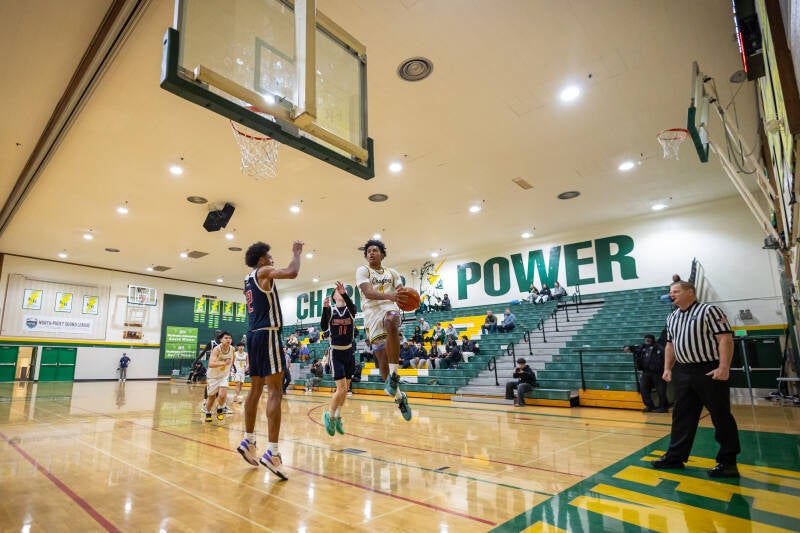
There’s a phrase you hear often in varsity basketball officiating circles:
“Don’t decide the game — let the players decide it.”
It sounds simple. Clean. Easy to agree with.
But once you’ve stood on a varsity floor with a packed gym, a one-possession game, emotional benches, and a clock winding down… you realize that phrase is much more complicated than it sounds.
Because the truth is this:
Letting the players decide the game does not mean swallowing your whistle.
And it definitely doesn’t mean avoiding a tough call in the final minute.
Over the years — through great games, tough losses, loud environments, and quiet drives home — I’ve learned that this phrase isn’t about doing less.
It’s about doing exactly what the moment requires — no more, no less.
The Misunderstanding Most Officials Start With
When officials first reach varsity, many of us carry an unspoken fear into close games:
“If I call something late, people will say I decided the game.”
So what happens?
-
We pass on marginal contact we called in the first quarter.
-
We hesitate on violations we would normally rule without thinking.
-
We hope the next possession makes the decision easier.
Without realizing it, we stop officiating the game that’s actually in front of us.
I’ve been there. Most honest officials have.
But here’s the turning point:
Avoiding a correct call doesn’t protect the game — it damages it.
Because players deserve consistency more than they deserve silence.
The Student-Athlete Perspective
Over the years — in postgame conversations and offseason workouts — I’ve asked players:
“What do you want from officials in the last minute of a close game?”
Their answers are simple and consistent.
One senior guard once told me:
“Just call it the same way you did all game. If it’s a foul earlier, it’s a foul late.”
A forward who battled in the paint said:
“When it gets more physical at the end and nothing gets called, it feels like skill doesn’t matter anymore.”
And a point guard shared something that stuck with me:
“We can live with a tough call. What’s hard is when no one knows what’s a foul anymore.”
That’s powerful.
Players don’t expect perfection.
They expect consistency.
They don’t want officials to disappear.
They want officials to be steady.
When the standard remains the same — advantage/disadvantage, legal guarding position, verticality — they adjust and compete.
When the standard changes because the clock is low, frustration replaces focus.
The Coach’s Perspective
Coaches view the final minute differently.
They’re thinking strategy, timeouts, matchups, foul situations, substitutions. Their minds are moving fast.
But most experienced varsity coaches will tell you something similar:
They want the game officiated the same way in the final minute as it was earlier.
One coach told me after a tight game:
“I can teach my players to adjust to your standard. I just can’t teach them to adjust if it changes.”
That’s honest.
Coaches spend hours preparing. They scout tendencies. They drill situational plays. They prepare for pressure.
When officiating becomes unpredictable late, preparation loses value.
But here’s something else about coaches:
In the heat of the moment, they may want silence if the call hurts them — and a whistle if it helps them. That’s human nature.
Our job isn’t to respond to emotional reaction.
It’s to apply the rule consistently.
When coaches walk away knowing the game was called the same from start to finish, respect follows — even if disagreement exists.
The Fan Perspective
Fans see the final minute through emotion.
They see:
-
The scoreboard
-
The clock
-
The colors they’re supporting
They don’t see:
-
Primary coverage areas
-
Off-ball displacement
-
Weak-side rebounding fouls
-
Advantage/disadvantage principles
They see outcomes.
And when a whistle blows late, the natural reaction is:
“You just decided the game!”
But here’s the reality:
If illegal contact occurs and it’s ruled correctly, the official didn’t decide the game.
The player who committed the foul impacted the outcome.
If a travel, block/charge, or displacement occurs and it’s properly ruled, the official didn’t insert themselves.
They enforced the standard.
Fans respond emotionally.
Officials must respond objectively.
That separation is critical.
Silence Can Decide a Game Too
One of the biggest lessons I’ve learned is this:
Not calling something can decide a game just as much as calling something.
When illegal contact alters rhythm, balance, speed, or quickness in the final seconds and it goes unaddressed, that’s not neutrality.
That’s inconsistency.
And inconsistency impacts outcomes.
If we allow the clock to influence enforcement, we’ve changed the environment the players have competed in all night.
That’s not letting them decide the game.
That’s letting pressure decide it.
A Personal Lesson I Won’t Forget
There was a rivalry game years ago — loud gym, tight score, final minute intense.
A drive to the basket. Clear body contact. Shot misses.
And in that split second, I hesitated.
No whistle.
Game ends shortly after.
Walking off the floor, no chaos. No scene.
But internally, I knew.
That wasn’t about “letting them play.”
That was about hesitation.
From that night forward, I committed:
If it’s a foul in the first quarter, it’s a foul in the last 10 seconds.
If it’s not, it’s not.
But the clock will never decide for me again.
That commitment builds integrity.
The Real Definition
Letting the players decide the game means:
-
Enforcing legal guarding position late, just as you did early.
-
Protecting verticality in the final drive the same way you protected it in the second quarter.
-
Applying advantage/disadvantage consistently.
-
Not upgrading marginal contact because of emotion.
-
Not downgrading a clear illegal contact because of fear.
It requires:
-
Emotional discipline
-
Crew communication
-
Confidence
-
Humility
It requires understanding that your job is not to disappear.
Your job is to protect fairness.
Final Thought
When the buzzer sounds, every group walks away with its own perspective:
-
Players walk away remembering effort.
-
Coaches walk away remembering execution.
-
Fans walk away remembering emotion.
-
Officials walk away remembering decisions.
But when the standard has remained consistent from start to finish, something important happens:
The game belongs to the players.
Not because officials avoided tough calls.
But because officials applied the rules without fear, without ego, and without influence from the clock.
Nothing more.
Nothing less.
That’s what letting the players decide the game actually means.
HAVE A TOPIC YOU WANT TO WRITE ON OR HAVE OUR STAFF WRITE ON CONTACT US. SARGE@CORACADEMYOFFICIATING.COM
Add comment
Comments