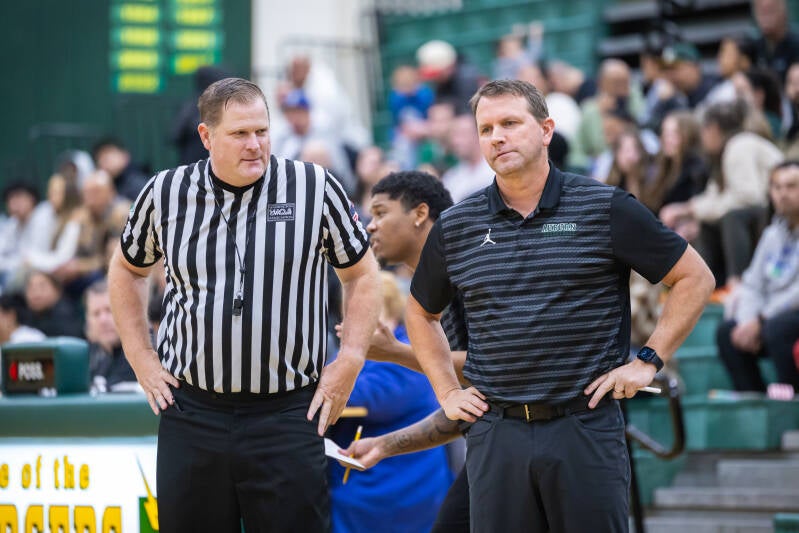
Few sounds in a high school gym change the atmosphere faster than a technical foul.
One whistle. Arms raised. The quiet pause before the reaction.
Sometimes it brings order. Sometimes it brings chaos. And sometimes… it brings a lesson that stays with an official for years.
Technical fouls are one of the most misunderstood tools in officiating. From the outside, they can look emotional, personal, or even dramatic. From the floor, they are supposed to be something very different:
A tool to restore balance, protect sportsmanship, and keep the game from slipping away.
But like any powerful tool, a technical foul can either help the game…or hurt it.
Understanding the difference is part of growing as an official at every level of high school basketball.
The Early Lesson Most Officials Learn
Most officials remember the first time they gave a technical foul.
Heart racing. Gym suddenly louder. Every eye in the building is turning toward you.
Early in an officiating career, technical fouls often feel like a test of courage. You wonder:
Did I act too fast? Did I wait too long? Did I just make the game about me?
Those questions are normal. Technical fouls sit at the intersection of rules, emotion, and game management.
And learning to handle that intersection takes time.
When a Technical Foul Truly Helps the Game
At its best, a technical foul is preventative, not punitive.
It stops behavior that is about to pull the game off course. It protects players from escalating emotion. It resets the environment so basketball—not frustration—decides the outcome.
You can feel when one is needed.
The temperature of the gym rises. Communication stops working. Warnings no longer change behavior.
In those moments, a well-timed technical foul doesn’t hurt the game.
It saves it.
Players refocus. Coaches reset. The crowd exhales. And the game returns to something recognizable.
That’s when a technical foul does exactly what it was meant to do.
When a Technical Foul Hurts the Game
But not every technical foul has that effect.
Some come from frustration instead of purpose. Some arrive too quickly, before communication has a chance to work. Others come too late, after the damage is already done.
And occasionally, a technical foul shifts attention away from the players and places it squarely on the official.
That’s when it hurts.
Because the goal is never to prove authority. The goal is always to protect the game.
When a technical foul becomes emotional instead of intentional, everyone in the gym can feel the difference.
And so can the official—especially later that night.
A Story That Still Teaches a Lesson
There was a varsity game years ago—tight score, loud crowd, rivalry energy. The kind of night where every possession felt heavier than normal.
Midway through the third quarter, a coach reacted strongly to a call. Nothing unusual at first. Just emotion in a competitive moment.
A quick response from the official. Another comment from the bench. Then the whistle.
Technical foul.
The gym exploded. because the behavior was shocking—but because the moment felt… rushed.
The rest of the game never fully settled. Every call felt louder. Every reaction felt bigger. And walking off the floor, there was a quiet realization:
The technical didn’t restore order. It became part of the noise.
No anger. No argument afterward. Just reflection.
And one important question:
What would better game management have looked like five seconds earlier?
That question changes how an official grows.
Communication Before the Whistle
One of the biggest differences between newer officials and experienced varsity officials is this:
Experienced officials use their voice before they use the whistle.
A calm word. Clear eye contact. Simple presence.
“Coach, that’s enough.” “I hear you. We’re moving on.” “Let’s stay with basketball.”
Small moments of communication often prevent big moments of conflict.
And when communication works, the game keeps flowing without the interruption of a technical foul.
But when communication no longer works—that’s when the whistle becomes necessary.
Courage Still Matters
Avoiding unnecessary technical fouls is important.
But so is not avoiding the necessary ones.
Some situations demand action:
-
Disrespect that crosses the sportsmanship line
-
Behavior that incites players or the crowd
-
Actions that threaten the emotional stability of the game
In those moments, hesitation doesn’t help anyone.
A clear, confident technical foul—given for the right reason, at the right time—can protect every person in the gym.
That kind of decision requires courage. Not emotional courage.
Professional courage.
The courage to act for the good of the game, not for comfort in the moment.
The View From Players and Coaches
Over time, conversations with players and coaches reveal something important:
They don’t actually dislike technical fouls.
They dislike inconsistent technical fouls.
Players want emotional control to be the same for both teams. Coaches want clear boundaries that they can understand. Everyone wants to know where the line is.
When that line is clear, technical fouls feel fair. When it isn’t, they feel personal—even when they aren’t.
Consistency, once again, becomes the center of good officiating.
Growth at Every Level of High School Basketball
This lesson isn’t just for varsity officials.
Sub-varsity games, middle school contests, and summer leagues all present moments where emotion challenges game control.
Learning when a technical foul helps—or hurts—is part of development at every level.
That’s why training, mentorship, and reflection matter so much.
Because technical fouls are never just about a single whistle.
They’re about:
-
Judgment
-
Timing
-
Emotional intelligence
-
Leadership under pressure
And those are the qualities that define strong officials.
The Quiet Reflection After the Game
Every official has moments they replay on the drive home.
Technical fouls are often part of those memories.
Not because they’re dramatic—but because they carry weight.
You ask yourself:
-
Did that help the game?
-
Did I communicate first?
-
Was my timing, right?
-
Would I handle it differently next time?
Those questions aren’t signs of weakness.
They’re signs of growth.
And growth is what turns experience into wisdom.
Final Thought
Technical fouls will always be part of high school basketball. They are necessary. They are meaningful. And when used correctly, they are protective.
But the best officials don’t measure success by how many technical fouls they give.
They measure success by something quieter:
How many games stayed under control without needing one.
Because in the end, the purpose of every decision—whistle or no whistle—is the same:
Protect the players. Respect the game. Lead with integrity.
When a technical foul does that, it helps.
When it doesn’t, it teaches.
And either way, it becomes part of the journey of becoming the kind of official the game deserves.
If you have a topic you'd like us to cover, or if you're interested in writing for us, please contact us at sarge@coracademyofficiating.com.
Add comment
Comments